The 2026 Nobel Prize in Chemistry: How Can Chemistry Choose a Mirror Image?
From molecular handedness to nonlinear effects and self-amplifying reactions, understand how tiny asymmetries can grow into a nearly one-sided chemical world.

mou7s
Hold up your hands with the palms facing you. They have the same parts in the same arrangement, yet no rotation can make the left hand fit perfectly on top of the right.
Some molecules have the same relationship. Their two forms are mirror images that cannot be superimposed. Chemists call this property chirality, from the Greek word for hand.
The 2026 Nobel Prize in Chemistry recognizes Henri B. Kagan and Kenso Soai “for the discovery of non-linear effects and autocatalysis in asymmetric organic synthesis.” Their work helps answer a deceptively simple question: how can a tiny preference for one molecular mirror image grow into an overwhelmingly one-sided result? Royal Swedish Academy of Sciences announcement
When mirror images are chemically different
The two mirror-image forms of a chiral molecule are called enantiomers. Chemists often label them R and S according to rules that describe the arrangement around a chiral centre.
In an ordinary non-chiral environment, the two forms can share many properties. They may have the same mass, boiling point and connectivity between atoms. But living systems are themselves chiral. Enzymes, receptors and proteins have three-dimensional shapes, so they can interact differently with two molecular forms that appear almost identical on paper.
A key may fit one lock but not its mirror image. This analogy explains shape recognition, although real molecular interactions are flexible and involve more than a rigid geometric fit.
This is why chemists care not only about making the right molecular formula, but also about making the desired three-dimensional form. A synthesis that produces equal amounts of both enantiomers gives a racemic mixture. An asymmetric synthesis instead favours one.
How do we measure the preference?
The balance is commonly expressed as enantiomeric excess, or ee:
If a sample contains 50% R and 50% S, its ee is 0%. A mixture containing 60% R and 40% S has 20% ee. A 99:1 mixture has 98% ee.
The value measures imbalance, not yield. A reaction can make very little material with high ee, or a large amount with poor ee. Both questions matter in practical synthesis.
Kagan: the response does not have to be linear
One way to favour an enantiomer is to use a chiral catalyst. A simple expectation would be that a catalyst with a modest enantiomeric imbalance produces a similarly modest imbalance in the product.
Kagan showed that this relationship can be strongly nonlinear. A relatively small change in the catalyst's enantiomeric composition can lead to a much larger change in the product's ee.
Why? Catalyst molecules do not necessarily act as isolated individuals. They can associate into pairs or larger structures. Same-handed and mixed-handed combinations may differ in stability or catalytic activity. As a result, the active population in the reaction can have a stronger preference than the catalyst mixture as a whole.
The important discovery was not merely that one reaction gave a surprisingly pure product. It was evidence that molecular interactions could amplify an initial chiral imbalance. Kagan's models and experiments gave chemists a way to reason about that amplification.
Soai: a product that helps make more of itself
Soai took the story further by discovering an asymmetric autocatalytic reaction.
In ordinary catalysis, a catalyst accelerates the conversion of starting materials into a product. In autocatalysis, the product itself helps catalyse the formation of more product.
For the Soai reaction, the handedness matters too:
a little R product → helps form more R product
a little S product → helps form more S product
That creates a feedback loop. If one enantiomer begins with even a slight advantage, it can help reproduce its own handedness. The growing product population then supplies more catalyst, strengthening the same pathway.
In the experiment reported in 1995, an initial 2% excess of one enantiomer grew to 87%. Later systems achieved yields above 99% and enantiomeric excess above 99.5%. Award background Soai's review
This is chemical positive feedback, but the phrase should not suggest unlimited growth. The reaction still depends on available starting materials and experimental conditions.
How can an almost invisible difference decide the outcome?
The Soai reaction can respond to remarkably small chiral influences. Researchers have initiated its preference using chiral crystals, circularly polarized light and molecules whose asymmetry arises only from isotopic substitution.
Such a trigger does not need to create a highly pure product directly. It only needs to establish a small imbalance above the background fluctuations. Autocatalytic amplification can then enlarge it.
The molecular mechanism is more complicated than a single product molecule copying itself. Studies indicate that product molecules associate, and that same-handed and mixed-handed assemblies participate differently in the reaction network. The central experimental result remains clear: the system can turn a minute initial difference into a large final excess. ACS Central Science mechanistic study
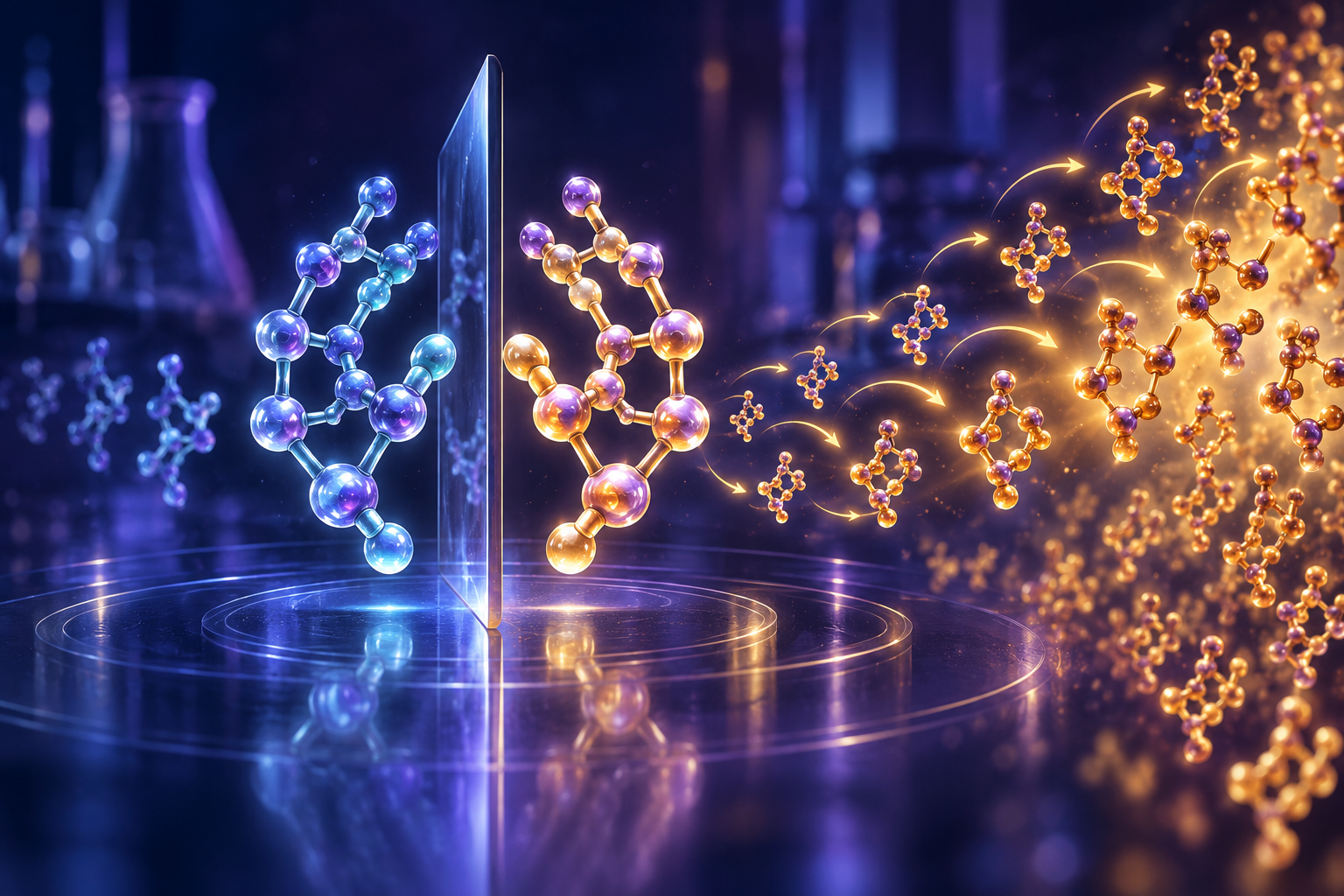
A conceptual illustration of chirality and amplification. The molecular shapes and arrows explain the idea; they are not a structural diagram or complete mechanism of the Soai reaction. Cover illustration generated for this article.
Why does life use one handedness?
Life is strikingly selective. Proteins are built primarily from L-amino acids, while the sugars in DNA and RNA have the opposite conventional handedness. This broad preference is called homochirality.
An environment without an existing chiral influence often gives no obvious reason for one mirror image to dominate. That produces a fundamental origin-of-life question: how could an early chemical system move from near equality to a persistent preference?
Asymmetric autocatalysis demonstrates a plausible type of process:
tiny accidental or environmental bias
                 ↓
handed product promotes more of itself
                 ↓
nonlinear amplification through feedback
                 ↓
a system dominated by one handedness
This does not prove that the Soai reaction occurred on the early Earth. Its particular reagents and conditions are not regarded as a realistic reconstruction of prebiotic chemistry. The experiment instead proves an important principle: chemistry can amplify an extremely small asymmetric influence rather than allowing it to disappear into a 50:50 mixture.
Researchers still need to identify pathways that are both capable of similar amplification and plausible under prebiotic conditions.
What does this have to do with medicine?
The award is not for a particular drug. Its connection to medicine is more foundational.
Modern drug development often needs control over molecular handedness because biological targets can distinguish between enantiomers. Asymmetric catalysis supplies methods for making one form selectively, reducing difficult separation steps and giving researchers tighter control over a compound's biological behaviour.
Kagan's work belongs to the intellectual development of highly selective asymmetric catalysis. Soai's reaction is especially important as a model of self-amplifying chirality; it is not a routine manufacturing method for most medicines.
Keeping that distinction matters. “Relevant to pharmaceutical chemistry” is not the same claim as “this exact reaction produces today's medicines.”
Why is this Nobel-worthy?
I understand the prize as recognizing a chain of ideas rather than one isolated recipe.
Kagan showed that chirality can be amplified through nonlinear interactions between catalysts. Soai discovered a reaction in which a chiral product promotes its own formation, turning amplification into a self-reinforcing chemical process.
Together, the discoveries connect practical synthesis with a deeper question about nature: how can asymmetry emerge and persist in a world whose underlying rules do not appear to prefer left over right?
The most memorable lesson is that a tiny difference need not remain tiny. In the right reaction network, chemistry can detect it, reproduce it and make it dominant.
Sources checked on 8 October 2026. The cover and feedback diagram are conceptual explanations, not complete representations of the Soai reaction mechanism.
Sources and further reading
- Royal Swedish Academy of Sciences: the 2026 Chemistry Prize
- Royal Swedish Academy of Sciences: award background
- Soai: enantioselective automultiplication by asymmetric autocatalysis
- ACS Central Science: mechanistic study of asymmetric amplification
- Chemical Reviews: autocatalytic models for biological homochirality
Hackintosh Installation Guide
A quick and practical way to install macOS on non-Apple hardware with OpenCore.
The 2026 Nobel Prize in Economics: Understanding the Complex Machine of the Modern Economy
From consumption and expectations to central bank policy, explore how Robert Hall and Michael Woodford shaped modern macroeconomics and the study of economies as complex systems.