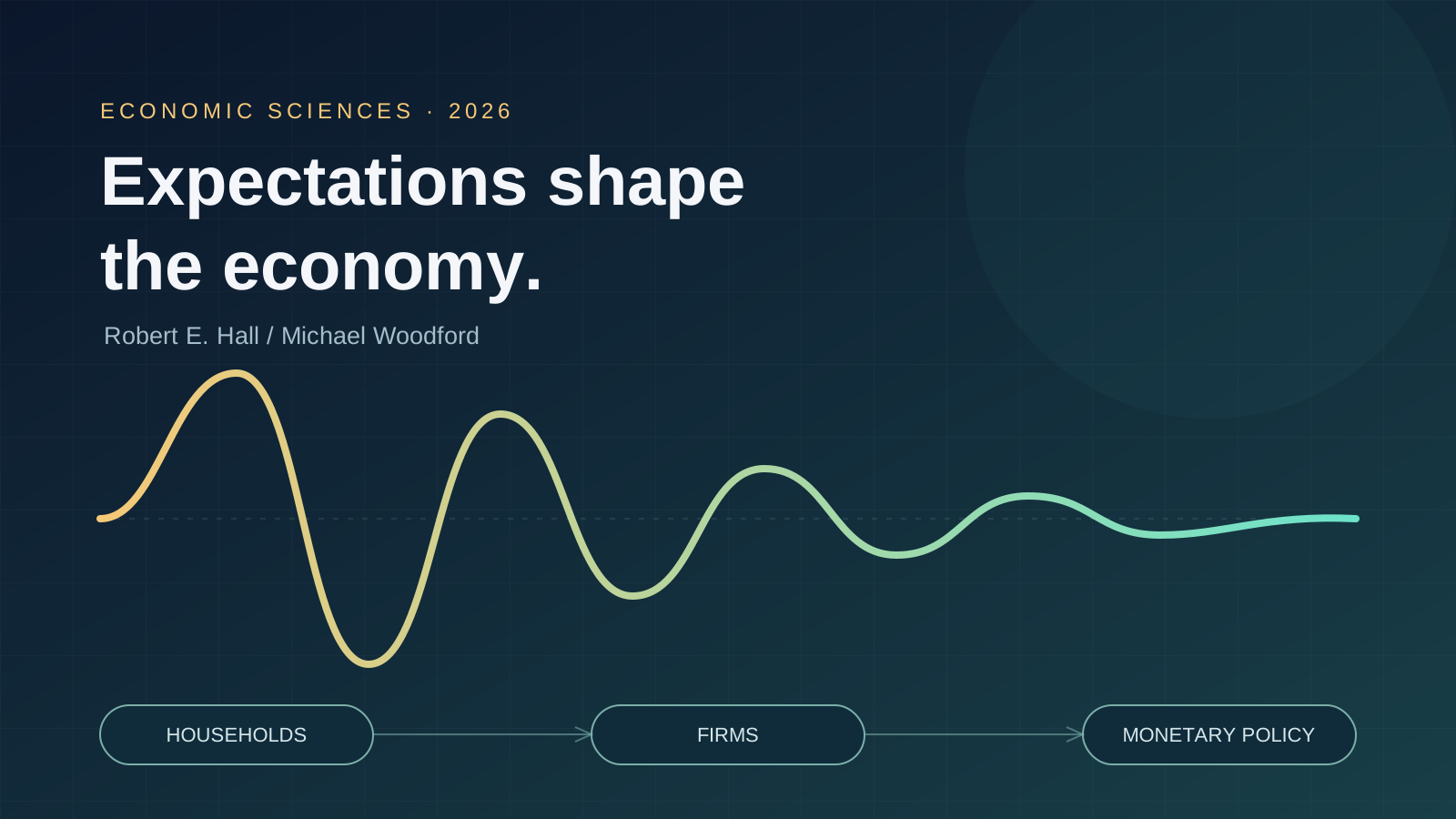
The 2026 Nobel Prize in Economics: Understanding the Complex Machine of the Modern Economy
From consumption and expectations to central bank policy, explore how Robert Hall and Michael Woodford shaped modern macroeconomics and the study of economies as complex systems.

mou7s
When people hear about the economics prize, their first reaction may be: what does this have to do with stocks, housing prices or wages?
But the 2026 Nobel Prize in Economics addresses a more fundamental question: how can we understand and manage an economic system made up of billions of individual choices?
This work connects individual behavior, economic fluctuations and the policy frameworks of modern central banks.
The award recognizes two central figures: Robert E. Hall, for his research on consumption and expectations, and Michael Woodford, for his contributions to modern monetary policy theory.
Their work helped advance modern macroeconomics. An economy is more than a handful of changing indicators: it is a complex system formed by interacting individual decisions.
Why do economies fluctuate?
If markets always worked efficiently, an economy should be able to return to equilibrium automatically.
When profits fall, firms cut costs. When wages fall, firms hire more workers. As prices adjust, supply and demand come back into balance.
This is an important idea in traditional classical economics.
Reality, however, does not always follow that pattern.
The 2008 financial crisis and the global inflation following the pandemic show that economies can remain out of balance for extended periods.
One reason is that the real world contains many “frictions”:
- Wages do not adjust immediately.
- Firms do not change prices instantly.
- People do not have complete knowledge of the future.
- Investment decisions depend on confidence.
These factors make the economy a more complicated dynamic system.
From current income to future expectations
One of Robert Hall’s important contributions concerns consumption behavior.
Many simple models used to assume:
When income rises, people consume more.
Actual behavior is more complicated.
A young engineer may earn relatively little today. If they expect their income to rise significantly, they may still be willing to invest in education, buy a home or make long-term spending commitments.
Conversely, someone with a high income may cut spending if they fear that economic conditions will deteriorate.
Consumption therefore depends not just on the present, but also on people’s judgments about the future.
This leads to an important idea:
Economic activity depends to a considerable extent on expectations about the future.
That is also why the signals conveyed by government policy announcements matter so much.
Why do central banks care about expectations?
Michael Woodford’s research further developed modern monetary policy theory.
People often explain central bank interest-rate decisions through a simple chain:
Higher interest rates → more expensive borrowing → less consumption and investment → lower inflation.
Modern economics emphasizes that the current interest rate is only part of the story. How people interpret the central bank’s future actions matters too.
For example, if a central bank clearly signals that it will maintain a restrictive policy for some time, firms may reduce investment and households may borrow less before those future decisions actually arrive.
In other words:
A central bank influences both today’s interest rate and society’s expectations about the future.
The “operating system” of modern economics: DSGE models
These lines of research helped develop dynamic stochastic general equilibrium models, or DSGE models.
The name sounds complicated, but one way to think of such a model is as an economic simulator.
It attempts to build a virtual economy describing:
- How people consume.
- How firms set prices.
- How banks lend.
- How governments make policy.
Researchers then introduce shocks such as:
- Rising energy prices.
- Financial crises.
- Technological change.
- A global pandemic.
They observe how the system responds.
This resembles a control-system problem in engineering: introduce a disturbance, analyze the response and look for ways to make the system more stable.
Why does this matter to ordinary people?
Many questions behind modern economic policy depend on these theories.
Why do central banks raise interest rates when inflation is high?
Why might lower interest rates stimulate economic activity?
Why does a one-time government payment not necessarily produce an equally large increase in consumption?
The answers all involve how people make decisions in light of the future.
Economics is not a perfect prediction machine
These models have also faced criticism.
After the 2008 financial crisis, many economists argued that traditional macroeconomic models did not adequately describe sudden collapses in the financial system.
Real people are not always rational calculators.
Panic, emotions, institutions and inequality all affect how an economy works.
Modern economics therefore continues to incorporate additional considerations:
- Behavioral economics.
- Financial frictions.
- Differences between income groups.
- Complex network models.
Seeing economics as a complex system
If physics studies natural laws and computer science studies information systems, modern economics studies a complex system made up of people.
Each person is a decision-making node: consuming, investing, working and saving.
Markets connect these local actions, which together produce changes in the global economy.
The significance of the 2026 economics prize goes beyond explaining how to predict GDP.
It points toward a broader idea:
To understand a complex system, we need to understand its participants’ behavior and their judgments about the future.
This is also where modern economics increasingly overlaps with research on artificial intelligence and multi-agent systems.
The 2026 Nobel Prize in Chemistry: How Can Chemistry Choose a Mirror Image?
From molecular handedness to nonlinear effects and self-amplifying reactions, understand how tiny asymmetries can grow into a nearly one-sided chemical world.
The 2026 Nobel Prize in Literature: How Anne Carson Makes Ancient Stories Hurt Again
A guide to Anne Carson through a modern monster’s coming of age, the bittersweet experience of desire, and mourning expressed through an accordion-fold book.